Electro-power-cell Energy Wins EPC Contract at a Key Node of the European Hydrogen Corridor
Integrated Wind–Solar–Hydrogen–Energy Storage EPC Project Moves into Implementation
As Europe accelerates the deployment of hydrogen infrastructure and cross-regional hydrogen networks gradually take shape, the engineering delivery capability of integrated energy systems has become a decisive factor in whether projects can be successfully implemented and operated over the long term.
Recently, Electro Power Cell Energy Technology (Shanghai) Co., Ltd. (EPC Energy) successfully won the bid for an integrated wind–solar–hydrogen production–energy storage EPC project located at a key node of the European Hydrogen Corridor.
Designed for real-world operational scenarios, the project places high demands on system stability, multi-technology coordination, and engineering executability, representing a typical large-scale integrated energy system engineering practice.
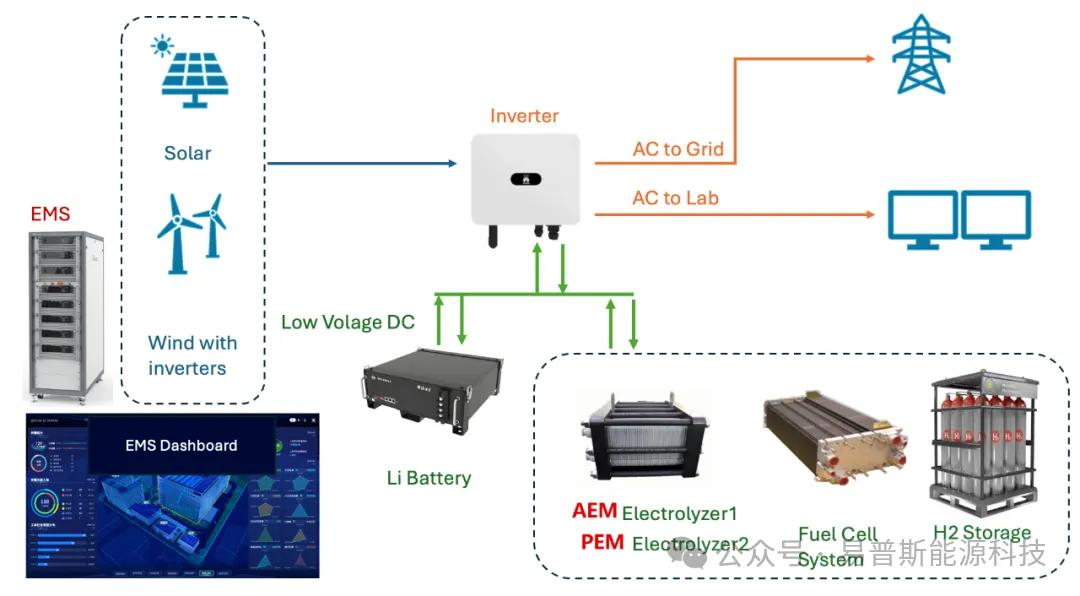
1. From Standalone Equipment to System Engineering
Unlike conventional renewable energy projects centered around a single technology or device, this project was designed from the outset with system-level coordination and clearly defined engineering boundaries as its core principles. The overall architecture includes:
Renewable energy generation: Coordinated configuration and output optimization of wind power and photovoltaic systems
Energy conversion: Parallel operation of multiple water electrolysis hydrogen production technologies
Energy storage: Multi-form storage and dispatch of both electrical energy and hydrogen
System control: Unified monitoring, dispatch, and optimization through an Energy Management System (EMS)
Within the highly constrained and complex operating environment of the European Hydrogen Corridor, system stability, controllability, and well-defined engineering interfaces are far more critical than individual performance indicators.
2. A Key Hydrogen Corridor Node: A Real Test of Engineering Capability
A “key node of the European Hydrogen Corridor” is not a conceptual label, but a designation that imposes significantly higher engineering requirements, including:
Compatibility with future cross-border and cross-regional hydrogen transmission networks
The ability to operate under grid-connected, off-grid, and fluctuating load conditions
Strict requirements for system redundancy, dynamic response speed, and long-term reliability
In this context, the value of the project lies not in demonstrating a single technical pathway, but in verifying the operational feasibility and stability of multiple technology combinations under real operating conditions.
3. Parallel Validation of Multiple Technology Pathways
In both hydrogen production and hydrogen storage, the project adopts an engineering strategy of parallel technology validation, rather than committing prematurely to a single route:
Hydrogen production: Simultaneous deployment of AEM and PEM water electrolysis systems
Hydrogen storage: Combined application of high-pressure gaseous hydrogen storage and Liquid Organic Hydrogen Carrier (LOHC) technology
By collecting long-term operational data within a unified engineering framework, the project enables direct comparison of different pathways in terms of efficiency, dynamic response, system coupling, and operational complexity, providing a solid engineering basis for future large-scale deployment.
This is not a competition between technologies, but a selection process driven by engineering reality.
4. The Essence of EPC Contracting: Delivering Complexity as an Operable System
As the EPC contractor, EPC Energy’s role extends far beyond equipment procurement and integration. The company is responsible for the full system engineering lifecycle, including:
Integrated energy system architecture design
Engineering coupling and interface management across multiple energy forms and media
Control logic design, operational strategies, and EMS implementation
Comprehensive management of risk boundaries, responsibilities, and project deliverability
True EPC capability is not about assembling equipment,
but about ensuring that the system can operate reliably, stably, and sustainably over time.
Conclusion | Engineering Execution Is the True Dividing Line for Integrated Energy Systems
In the hydrogen and integrated energy sectors, concepts are abundant, and technical pathways are widely discussed.
What is truly scarce is the ability to deliver complex systems that have already entered the engineering implementation stage and can be deployed at critical infrastructure nodes.
This project is not a memorandum, nor a conceptual demonstration, but an ongoing integrated energy EPC engineering project moving steadily toward real-world operation.