China's First 3000 cm² Electrochemical DAC Electrolyzer System Successfully Delivered by EPC Energy
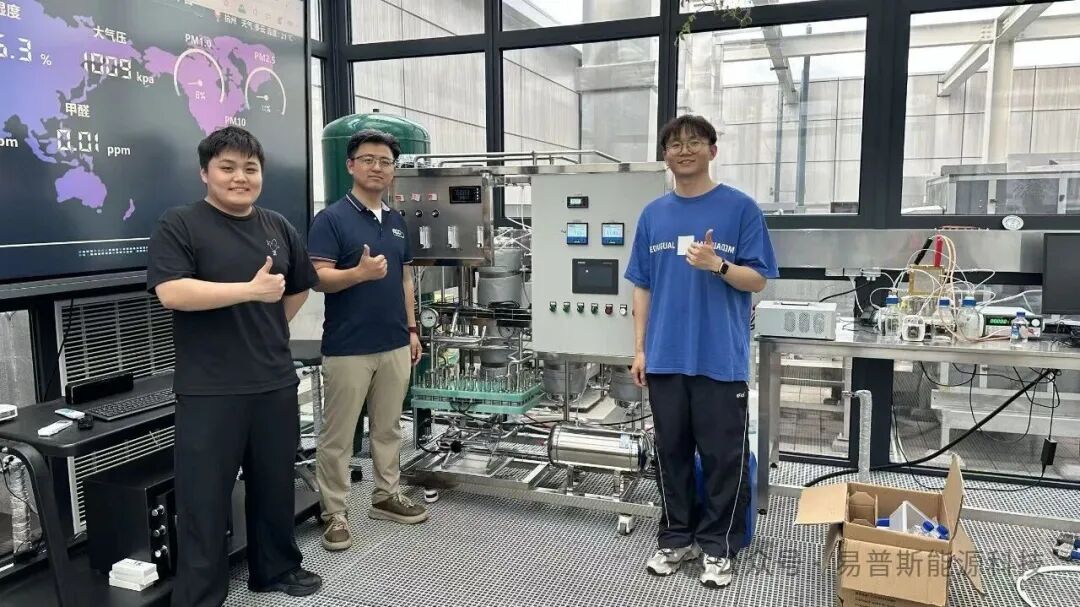
Recently, EPC Energy (Electro-Power-Cell Energy and Technology Ltd.) officially completed the delivery of China’s first 3000 cm² solid-electrolyte electrochemical Direct Air Capture (DAC) electrolyzer system.
The platform will be used for research in carbon conversion and biotechnology integration, further advancing the coupling of DAC and carbon utilization technologies from laboratory-scale validation toward continuous engineering operation.
This delivery also marks a significant milestone in the development of large-area electrochemical DAC engineering platforms in China.
DAC Is Entering the Era of “System Engineering”
Over the past several years, the global Direct Air Capture (DAC) industry has experienced rapid growth.
However, the industry is increasingly realizing that:
The key factor determining whether DAC can truly achieve commercialization is not only the adsorbent material itself, but whether the entire system can operate continuously and reliably over the long term.
Especially with the emergence of next-generation electrochemical DAC pathways, industry focus is gradually shifting from isolated material performance metrics toward integrated system engineering capability.
Globally, increasing attention is being directed toward technologies such as:
Electrochemical Acidification Regeneration (ECR)
Solid Electrolyte DAC
Bipolar Membranes (BPM)
Electric-Field-Assisted Regeneration
Humidity Swing + Electrochemical Coupling
At the same time, engineering challenges associated with DAC systems are becoming increasingly complex, including:
Air-side mass transfer efficiency
Regeneration energy consumption
Electrochemical stability
Thermal and water management
Modularization and scale-up capability
Automation and control systems
Long-duration operational reliability
This means that:
DAC industry competition is evolving from “laboratory material competition” into “system engineering competition.”
3000 cm²: More Than a Scale-Up — A Validation of Engineering Capability
Compared with traditional laboratory-scale electrochemical units, a 3000 cm² electrochemical DAC platform represents an entirely different level of engineering complexity.
Large-area electrochemical DAC systems must address challenges such as:
Complex flow-field design
Advanced sealing and pressure-drop management
Higher thermal and water management requirements
Ion transport consistency across large areas
Continuous operational stability
As a result, this is no longer a simple laboratory device.
It is:
A platform-level engineering system designed for continuous operation and industrial validation.
The delivered system integrates:
Solid-electrolyte DAC electrochemical modules
PLC + HMI automation control systems
Online monitoring and data acquisition
Multi-channel fluid management systems
Continuous circulation loops
Modular skid-mounted engineering structures
The platform will support future research in:
Electrochemical DAC regeneration
Carbon conversion and biotechnology coupling
Integrated carbon capture and utilization
Long-term operational stability
Engineering scale-up validation
Moving Beyond Carbon Capture Toward Carbon Conversion
Within the global low-carbon technology landscape, DAC is no longer viewed solely as a method for capturing CO₂.
The more important question now is:
How can captured CO₂ truly enter the industrial value chain?
As a result, the integration of DAC with carbon utilization technologies is becoming a major direction for future low-carbon industries.
These pathways include:
CO₂ Electrolysis (CO₂RR)
Green Methanol
Green Methane
e-Fuels
Synthetic Fuels
Bio-conversion
Power-to-X Systems
As DAC, CO₂RR, water electrolysis, and sustainable fuel technologies increasingly converge, a new interdisciplinary ecosystem is emerging across the global energy transition landscape.
The Integration of Electrochemical DAC and Power-to-X Is Accelerating
The future of Power-to-X systems will not simply involve connecting individual pieces of equipment.
Instead, it will require:
Integrated operation between carbon capture, green hydrogen, electrochemical conversion, and energy systems.
For example:
DAC captures CO₂ directly from air
PEM/AEM electrolysis systems generate green hydrogen
CO₂RR converts captured CO₂ into CO or syngas
Downstream synthesis systems produce green methanol, green methane, and e-Fuels
Ultimately forming a fully integrated zero-carbon energy cycle.
In this process, the true determinant of competitiveness is no longer single-point performance, but rather:
System operational stability
Thermal integration capability
Automation and control capability
Modular engineering design
Long-duration reliability
Engineering scale-up and delivery capability
EPC Energy: Bringing Advanced Electrochemical Technologies Into the Real World
EPC Energy (Electro-Power-Cell Energy and Technology Ltd.) has consistently believed that:
The true challenge of low-carbon technology is not simply achieving higher laboratory performance data, but enabling technologies to operate reliably in real industrial environments.
Today, EPC Energy continues advancing engineering and system integration capabilities around:
Direct Air Capture (DAC)
CO₂ Electrolysis (CO₂RR)
PEM/AEM Electrolysis Systems
Hydrogen Energy and Power-to-X
e-Fuels and Sustainable Fuels
Modular Low-Carbon Systems
Rather than focusing solely on laboratory performance, we place greater emphasis on:
The critical engineering transition between experimental validation, engineering demonstration, and pilot-scale deployment.
Because the future competitive advantage of the low-carbon industry will ultimately belong to companies capable of:
Turning advanced technologies into stable, continuously operating industrial systems.
From Electrochemistry to System Engineering
From Direct Air Capture to Carbon Conversion
Moving forward, EPC Energy (Electro-Power-Cell Energy and Technology Ltd.) will continue using system engineering as its core foundation to advance:
Direct Air Capture (DAC)
CO₂ Electrolysis (CO₂RR)
Green Hydrogen Systems
Power-to-X
e-Fuels
Modular Zero-Carbon Energy Systems
from laboratory research toward real industrial deployment.
We will also continue exploring:
New possibilities for integrating carbon capture, carbon conversion, and renewable energy systems.