Reassessing DAC from an Engineering Perspective | EPC Energy’s System-Level Insights from the 2025 DAC / DOC / Bio-based CO₂ Technology Forum
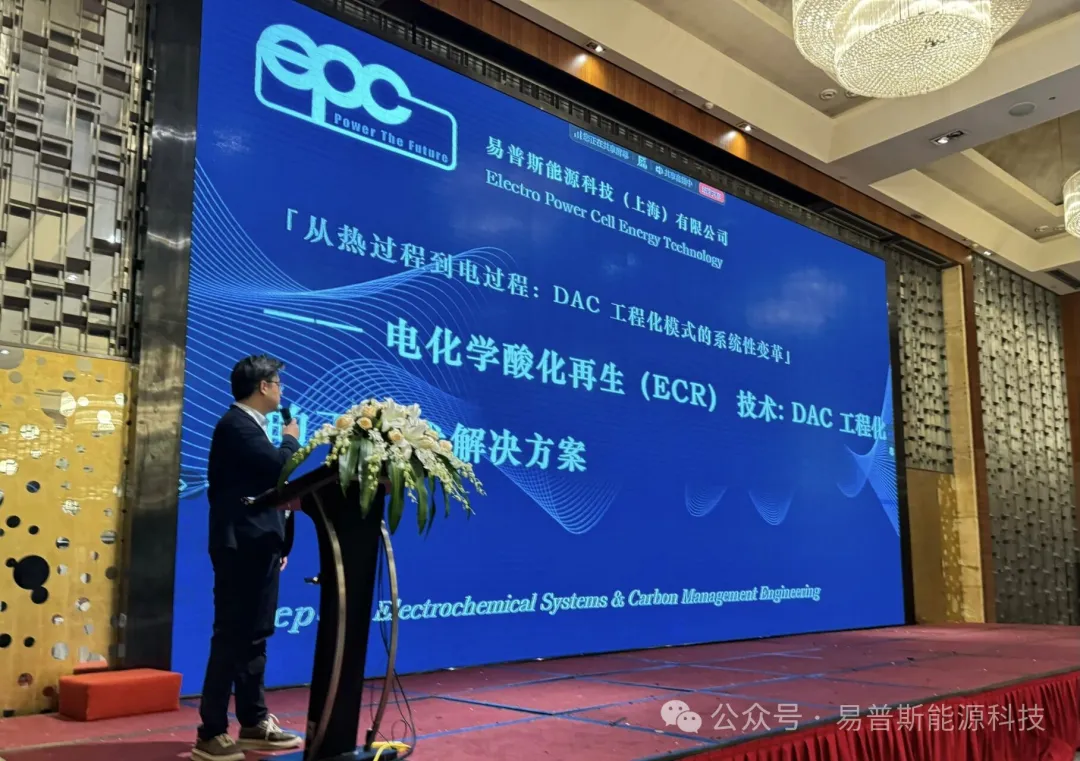
Electro Power Cell Energy Technology was invited to participate in the 2025 Direct Air Capture (DAC), Direct Ocean Capture (DOC), and Bio-based CO₂ Technology Forum, held in Chengdu. At the forum, EPC Energy delivered a technical presentation focusing on the engineering pathways of DAC, entitled:
“From Thermal Processes to Electrical Processes: A Systemic Transformation of DAC Engineering —
Electrochemical Regeneration (ECR) as an Engineering Solution for Carbon Capture”
The forum brought together multiple technical approaches from materials science, chemical engineering, system engineering, and industrial practitioners, providing a comprehensive platform to discuss how carbon capture technologies can transition from laboratory research to real-world engineering systems.
Throughout the discussions, one consensus became increasingly clear:
The core challenge of DAC is shifting from capture mechanisms to long-term, stable, and replicable system operation.
1. A Shift in Focus for Direct Air Capture (DAC)
Across the forum sessions, a clear transition in industry priorities was evident.
Historically, DAC discussions have concentrated on:
Adsorbent or solvent performance
CO₂ capture efficiency per unit mass
Cycle stability at laboratory scale
Today, the conversation is increasingly grounded in engineering reality, addressing questions such as:
Where does the system’s energy consumption originate?
Can the system operate reliably over long periods?
Can DAC be deployed as skid-mounted equipment or modular DAC systems at scale?
Whether in Direct Air Capture (DAC) or broader carbon capture applications, engineering operability has emerged as the decisive factor for future deployment.
2. DAC Engineering Transformation: From Thermal to Electrical Processes
In its presentation, EPC Energy shared a clear engineering judgment regarding DAC engineering pathways:
When CO₂ regeneration relies heavily on large-scale heating, DAC systems inevitably become heavier, slower in response, more complex, and more difficult to integrate with renewable energy sources.
Against this background, EPC Energy introduced the application logic of Electrochemical Regeneration (ECR) in DAC engineering.
Rather than positioning ECR as a “disruptive” concept, it was presented as a solution aligned with real system engineering constraints.
By using electrical processes to locally construct chemical potential, ECR enables controlled and efficient regeneration, offering a more practical route toward engineering-scale DAC operation.
3. The System-Level Value of ECR: Enabling Modular and Integrated DAC Systems
From a system engineering perspective, the value of ECR lies in its impact on overall system design:
Regeneration shifts from bulk thermal heating to electrochemical driving forces
Systems are more easily configured as modular DAC systems and skid-mounted units
Faster dynamic response enables effective renewable power coupling
Interfaces are more compatible with CO₂ electroreduction (CO₂RR) and PtX systems
This is not a pursuit of isolated efficiency metrics, but a system-level choice made in service of DAC engineering feasibility and scalability.
4. DAC as a Functional Module within Carbon Management and PtX Systems
Another key consensus emerging from the forum is that DAC is no longer viewed as a standalone capture device, but rather as a functional module within a broader carbon management system.
This shift implies that DAC technologies must address:
Interfaces with CO₂ electroreduction, synthetic fuels, and other PtX pathways
Synergy with hydrogen production, power systems, and renewable electricity coupling
Validation under long-term, system-level operating conditions
From this perspective, ECR is not an endpoint. However, it significantly lowers the barriers for DAC integration into skid-mounted equipment, modular systems, and real industrial energy infrastructures.
Conclusion | Carbon Capture Ultimately Returns to Engineering Systems
The technical exchange in Chengdu further reinforced a fundamental understanding:
For carbon capture and Direct Air Capture (DAC), the true dividing line is not academic performance indicators, but engineering systems.
Multiple technical routes may coexist, and parallel exploration is necessary.
Ultimately, the solutions that endure will be those that can:
operate reliably over the long term,
be modularized and replicated,
and integrate seamlessly into PtX frameworks and renewable energy systems.
This applies to DAC,
and to the entire carbon management ecosystem as well.